Ali-Dunn 1976: Inside Boxing's Strangest Title Fight
How Ali-Dunn in Munich became boxing's strangest title fight, from a last-minute challenger to a 3 a.m. start.
This article was generated with AI assistance and reviewed by our editorial team.
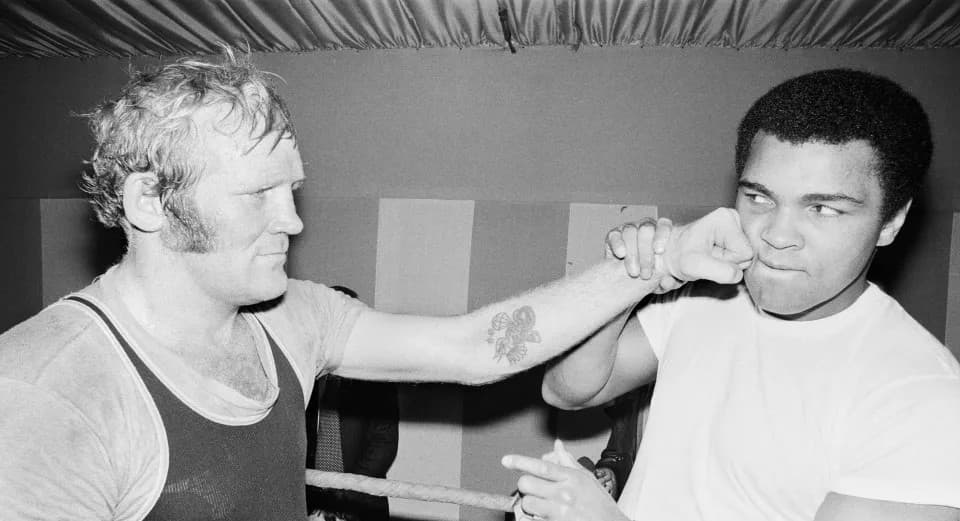
Muhammad Ali stopped Richard Dunn in the fifth round on May 24, 1976, at Munich's Olympiahalle, recording the final knockout victory of his professional career. The fight almost never happened the way it did, and the circumstances around it say as much about Ali's chaotic mid-1970s stretch as the finish itself.
Ali came in at 220 pounds carrying a 51-2 record with 36 knockouts. Dunn, a 31-year-old former paratrooper and working scaffolder from Bradford, weighed 207 and held the British, Commonwealth and European titles. German promoters had actually built the whole show around a different challenger, expecting Bernd August to win the vacant European title and give Ali a hometown opponent. Dunn blew that plan up by stopping August in the third round at the Royal Albert Hall just seven weeks before the Munich date, and suddenly a scaffolder from Bradford was fighting the most famous athlete alive.
Why Ali took this fight only 24 days after Jimmy Young
Dunn was Ali's third title defense in barely three months, a pace that had already caught up with him. Ali had stopped Jean Pierre Coopman in February, then labored through 15 rounds against Jimmy Young in April in a fight where he looked slow and frustrated, escaping exchanges by leaning through the ropes rather than moving his feet. He got the unanimous decision, but the performance drew real criticism, and Munich was supposed to be the bounce-back. Dunn's straight-ahead, aggressive style gave Ali a far simpler puzzle than Young's movement and defensive tricks.
The money behind that scheduling crunch was real. Ali was juggling training camps and promotional obligations across Puerto Rico, Maryland and West Germany to keep purses flowing for his entourage and expenses, and even the Dunn fight nearly collapsed days beforehand over a $225,000 dispute involving Ali's purse and German taxes. Ali ended up covering a shortfall in Dunn's own purse and separately spent $100,000 buying 2,000 tickets for American servicemen near Munich, a gesture that still couldn't save the live gate. The main event started around 3 a.m. local time to hit NBC primetime in the U.S., and between that brutal hour and high ticket prices, promoters reportedly lost between $300,000 and $500,000 even with Ali and Dunn both getting paid in full, Ali around $1.6 million and Dunn about $100,000, the biggest payday of his career.
Did Dunn's southpaw stance give Ali trouble
Ali had long treated southpaws as a genuine problem, a belief that traced back to the uncomfortable moments Karl Mildenberger gave him from the left-handed stance in their 1966 title fight. Dunn exposed the limits of that theory. He came at Ali upright, followed him around the ring instead of cutting it off, and led with looping punches that gave Ali time to see them coming and answer. A faster, more deceptive southpaw might have exploited Ali's low left hand and his habit of pulling straight back from punches, but Dunn didn't have the hand speed or disguise to make the stance matter. Ali waited for Dunn to square up and started finding him with short right hands, setting up the stoppage.
Betting Angle
There's no modern line to price here since this is a historical fight, but the matchup itself is a useful betting lesson that still applies: stance and style matchups only move a line as far as the fighter's technical ability lets them. Books and bettors often bump up a southpaw's odds against an orthodox favorite almost reflexively, and Dunn's fight is the textbook case for why that shortcut fails. A live betting handicapper today should weigh a southpaw's actual angles, hand speed and defensive discipline before assuming the stance alone creates an edge.
Frequently Asked Questions
Who did Muhammad Ali knock out in his last career knockout win?
Muhammad Ali recorded the final knockout of his career against Richard Dunn, stopping him in the fifth round on May 24, 1976, at Munich's Olympiahalle.
Why was Richard Dunn fighting Muhammad Ali instead of Bernd August?
German promoters had expected Bernd August to win the vacant European title and challenge Ali, but Richard Dunn stopped August in the third round at the Royal Albert Hall seven weeks before the Munich date, taking the title shot for himself.
How much did Muhammad Ali and Richard Dunn get paid for their 1976 fight?
Muhammad Ali's purse was reported at approximately $1.6 million after adjustments, while Richard Dunn received about $100,000, the largest payday of his career.